
Choosing the right ecommerce platform is one of the most important decisions you’ll make for your online store. Get it wrong and you’ll spend years fighting your own website to rank well in search. Get it right and SEO becomes something the platform actively supports, rather than something you constantly work around. The fact that you’re here, asking which ecommerce platform is best for SEO, means you’re on the right track.
There are dozens of ecommerce platforms out there, all claiming to be SEO-friendly. In this guide, we’re going to cut through the noise and focus on the three platforms UK businesses ask us about most: Shopify, WooCommerce, and BigCommerce. We’ll look at what each one does well, where it falls short, and which type of business it suits best.
We’ll also make a clear recommendation, because “it depends” isn’t particularly useful when you’re trying to make a decision.
Does Your Ecommerce Platform Actually Affect SEO?
Yes, significantly. Your platform shapes almost everything that determines how well your store ranks in Google. That includes URL structure, page speed, schema markup, meta tag control, blogging capability, and how easy it is to make on-page changes. A platform that limits your control over these elements isn’t just inconvenient, it actively restricts your ability to compete in organic search.
The good news is that all three platforms we’re covering give you the core SEO fundamentals. The differences come down to how much control you have, how much technical knowledge is required, and how much ongoing maintenance you can realistically manage. Those differences matter enormously for UK SMEs who don’t always have a dedicated development team on call.
Before we get into the comparison, it’s also worth saying this: the platform is only the foundation. SEO needs to be built into your store from day one, not treated as something you add later. We see this mistake regularly: a business builds a store, launches it, and then asks about SEO six months down the line. By that point, there’s often structural work to undo before the real SEO work can begin. The platform you choose affects how straightforward or complicated that process is.

Shopify: The Simplest Platform to Get Right
Shopify is the most popular ecommerce platform in the world, and for good reason. It’s fully hosted, fast out of the box, and handles the technical side of running a store so that you don’t have to. From an SEO perspective, it gives you a solid foundation without needing a developer.
What Shopify Does Well for SEO
Shopify automatically generates XML sitemaps, adds canonical tags, and produces mobile-optimised pages from the start. You can edit meta titles and descriptions on every page, product, and collection without touching code. It integrates cleanly with Google Search Console and Google Analytics, which makes performance tracking straightforward. Site speed is generally strong on Shopify, particularly on newer themes, which matters for Core Web Vitals and rankings.
The Shopify app marketplace also includes dedicated SEO tools. Apps like Smart SEO and SEO Manager handle structured data, image alt text, and more advanced optimisation tasks for stores that want to go further without developer support.
Where Shopify Falls Short
Shopify has some well-documented limitations that frustrate SEO professionals. URL structures are partially fixed. Product pages must sit under /products/ and blog posts under /blogs/news/, which you can’t change. Duplicate content can become an issue with product variants and collection filters if you’re not careful. The blogging functionality is basic compared to WordPress, which matters if content marketing is a core part of your SEO strategy.
Monthly costs can also climb quickly, especially once you factor in apps, transaction fees if you’re not using Shopify Payments, and premium themes.
Who Shopify Suits Best
Shopify is the strongest choice for businesses that want a reliable, fast, manageable store without in-house development resource. If your SEO strategy is primarily product and category-page focused rather than content-heavy, Shopify gives you everything you need without unnecessary complexity.

WooCommerce: The Most Flexible Option for SEO
WooCommerce is a free, open-source plugin for WordPress. Because it inherits the full power of WordPress, the platform behind more than 40% of all websites, it offers a level of SEO flexibility and control that no hosted platform can match. It’s the platform we use most frequently for ecommerce website development projects at Yellow Circle, largely because of how well it supports an integrated SEO and content strategy.
What WooCommerce Does Well for SEO
WooCommerce’s biggest advantage is that it runs on WordPress, giving you access to plugins like Yoast SEO and Rank Math. These tools give you granular control over every on-page SEO element, from meta titles and descriptions to schema markup, breadcrumb trails, XML sitemaps, and readability guidance. You can fully customise URL structures across every page type: products, categories, blog posts, and static pages, without restriction.
Content marketing is where WooCommerce genuinely pulls ahead. WordPress was built as a content management system first, and that heritage shows. If your SEO strategy involves a blog, buying guides, comparison articles, or any kind of content that earns rankings beyond product pages, WooCommerce on WordPress is the more capable platform. Internal linking, taxonomies, and editorial workflow are all far more developed than on any hosted platform.
There are no ongoing platform fees beyond hosting, which typically costs far less than a Shopify plan at scale.
Where WooCommerce Falls Short
WooCommerce requires more technical involvement than Shopify. You’re responsible for hosting, security, updates, and plugin compatibility. Too many poorly maintained plugins can slow a site down, which directly affects rankings. You’ll need either internal technical capability or a reliable agency partner to keep the site healthy.
Setup and ongoing maintenance take more time and expertise than Shopify. For businesses without a development partner, that overhead can be significant.
Who WooCommerce Suits Best
WooCommerce is the better choice if content marketing is central to your SEO strategy, if you need full control over your URL structure and on-page elements, or if you’re building a store that will grow in complexity over time. It’s also the right choice if you’re already on WordPress or are planning to integrate your store into an existing WordPress site.

BigCommerce: The Enterprise-Ready Middle Ground
BigCommerce is a hosted platform like Shopify, but it’s built with larger, more complex catalogues in mind. It’s a strong performer from a technical SEO perspective and has fewer of the URL restrictions that frustrate Shopify users.
What BigCommerce Does Well for SEO
BigCommerce offers full control over URL structures for products, categories, and pages. It handles faceted navigation and filter pages better than most platforms, which is significant for stores with large catalogues where duplicate content and crawl budget can become problems. It includes built-in schema markup, AMP support, and strong CDN performance.
BigCommerce also integrates with a wide range of SEO and analytics tools and doesn’t charge transaction fees regardless of your payment provider, which removes a cost variable as you scale.
Where BigCommerce Falls Short
BigCommerce is less intuitive for non-technical users than Shopify, and the blogging capability, while better than Shopify’s, still doesn’t match WordPress. Monthly costs are comparable to Shopify and can increase as you hit revenue thresholds. It also has a smaller UK ecosystem of developers and agencies compared to Shopify or WordPress.
Who BigCommerce Suits Best
BigCommerce suits mid-market and enterprise businesses with large product catalogues, multiple categories, and a need for strong technical SEO out of the box. It’s less commonly the right choice for UK SMEs who are starting out or who have straightforward catalogue requirements.
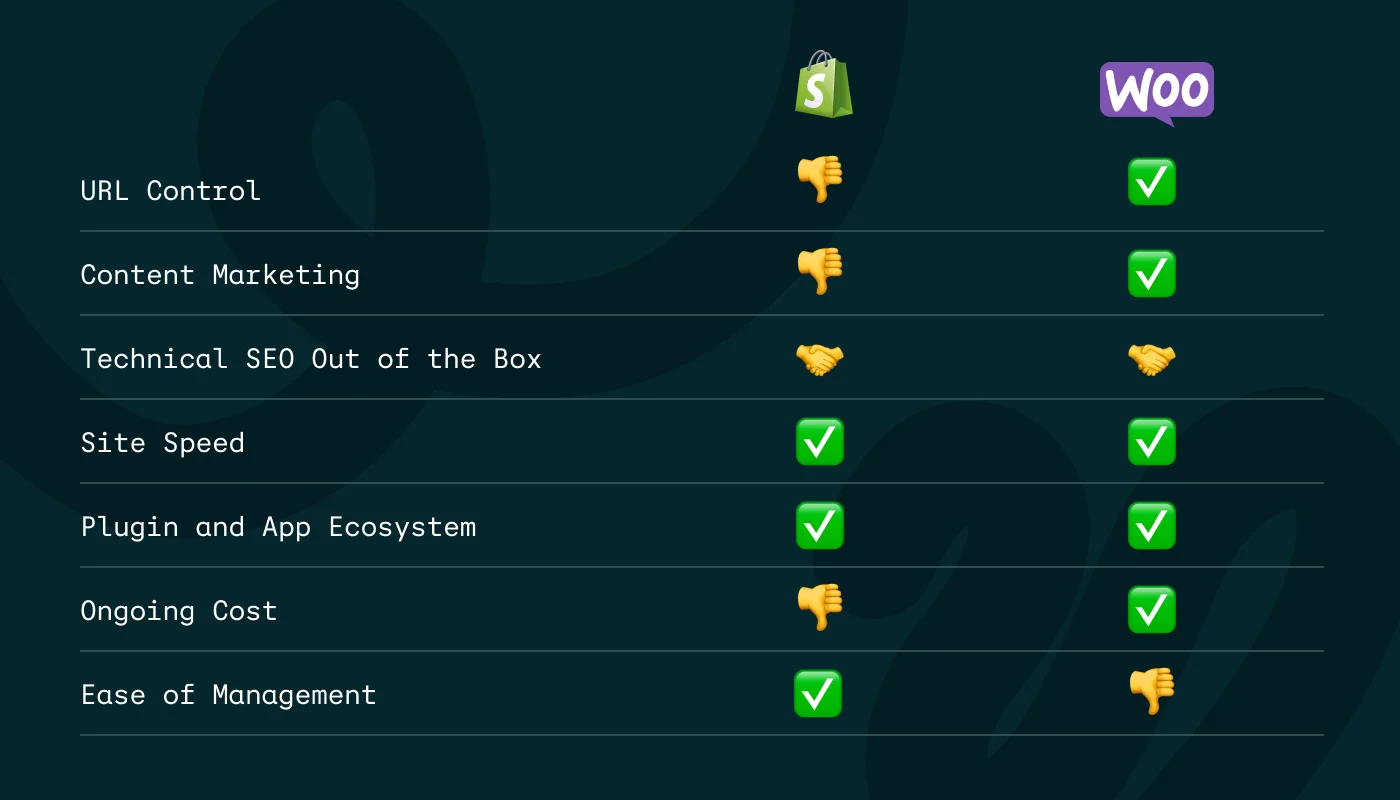
Shopify vs WooCommerce for SEO: A Direct Comparison
Most UK businesses are deciding between Shopify and WooCommerce, so it’s worth being direct about how they compare on the factors that matter most for SEO.
- URL control: WooCommerce wins. Shopify restricts product and blog post URL structures; WooCommerce gives you full control.
- Content marketing: WooCommerce wins. WordPress is simply a better content platform, with more sophisticated editorial tools, internal linking options, and content architecture.
- Technical SEO out of the box: Shopify is simpler to get right quickly; WooCommerce is more capable but requires more setup.
- Site speed: Both can be fast. Shopify has an edge for stores that aren’t well managed; WooCommerce with good hosting and a lean setup can match or beat it.
- Plugin and app ecosystem: Both are strong. Yoast SEO and Rank Math on WooCommerce give more granular control than most Shopify SEO apps.
- Ongoing cost: WooCommerce is typically lower cost at scale, though hosting quality matters.
- Ease of management: Shopify is easier for non-technical users. WooCommerce benefits from developer support.
If you’d like help building an SEO strategy alongside your store, our SEO service is designed to work alongside your ecommerce build rather than as a bolt-on after the fact.
What to Look for in an Ecommerce Platform for SEO
Whichever platform you choose, these are the SEO fundamentals it needs to support well. Use this as a checklist when you’re evaluating your options.
- Editable meta titles and descriptions on every page, product, and category.
- Clean, customisable URL structures that reflect your site hierarchy.
- Automatic XML sitemaps that update as you add products and pages.
- Schema markup support for products, reviews, breadcrumbs, and FAQs.
- Canonical tag control to prevent duplicate content issues, especially with product variants.
- Fast page load times and strong Core Web Vitals performance.
- Mobile-optimised themes as standard.
- A blog or content area that lets you publish and optimise supporting content.
- Google Search Console and Analytics integration without custom development.
All three platforms we’ve covered tick most of these boxes. The differences lie in how much manual work is required, and how much flexibility you have when you need to go beyond the defaults.
It’s also worth factoring in your website’s technical health from the start. A technically clean store on any platform will outperform a technically messy one, regardless of which platform you chose. Our website audit service can help you identify any issues before they affect rankings.

So, Which Ecommerce Platform Is Best for SEO?
There isn’t one universal answer, but there is a clearer answer than most guides give you.
If ease of management and reliability are your priorities, and your SEO strategy centres on product and category pages rather than content marketing, Shopify is the right choice. It gives you a fast, technically sound store without requiring ongoing development support.
If content marketing is central to your SEO strategy, or you need full control over your site architecture and URL structure, WooCommerce on WordPress is the better platform. It’s more work to set up and maintain, but it’s more capable in the long run and gives you the content infrastructure that SEO at scale requires.
If you’re running a large catalogue with complex navigation requirements, BigCommerce deserves serious consideration alongside WooCommerce.
The most important thing is this: whatever platform you choose, make sure SEO is built in from the beginning. Platform choice is only the starting point. The structure of your categories, the quality of your product pages, the depth of your content, and the technical health of your site all matter just as much. We covered this in more detail in our ecommerce website development service, if you’d like to explore the broader picture.
If you’re in the early stages of planning a new ecommerce store and want to make sure it’s built with SEO in mind from day one, we’d be happy to help. Yellow Circle has been building ecommerce websites and digital marketing strategies since 2006, and we work with businesses across Staffordshire, Cheshire, Shropshire, and the West Midlands, get in touch.
Frequently Asked Questions
Is Shopify or WooCommerce better for SEO?
It depends on your SEO strategy and technical resource. Shopify is easier to manage and gives you a technically solid store without developer support. WooCommerce, built on WordPress, offers more flexibility, better content marketing capability, and full control over URL structures. If content marketing is a core part of how you plan to attract organic traffic, WooCommerce is the stronger platform. If you want something reliable and manageable without ongoing development work, Shopify is the better fit. Most UK SMEs who work with an agency partner find WooCommerce gives them more room to grow.
Does the ecommerce platform I choose affect my Google rankings?
Yes, directly. Your platform determines how much control you have over the technical elements that Google uses to evaluate and rank your pages. These include URL structure, page speed, schema markup, meta tags, canonical tags, and mobile usability. A platform that limits your control over these factors will limit your SEO potential, regardless of how good your products or content are. The platform you choose also affects how easy it is to make ongoing SEO improvements, which is just as important as getting the foundations right at launch.
Is WooCommerce good for SEO?
WooCommerce is widely considered one of the best ecommerce platforms for SEO, largely because it runs on WordPress. WordPress gives you access to powerful SEO plugins like Yoast SEO and Rank Math, full control over URL structures, and a far more capable content management system than any hosted platform. The trade-off is that WooCommerce requires more technical involvement to manage well. With the right hosting and a reliable development partner, a well-built WooCommerce store can perform exceptionally well in organic search.
What ecommerce platform is best for a small UK business?
For most small UK businesses, the choice comes down to how you plan to attract customers. If you’re relying primarily on paid advertising and social media to drive traffic, Shopify gives you a fast, manageable store without technical complexity. If organic search is a key part of your strategy, WooCommerce on WordPress gives you the content infrastructure and flexibility to compete effectively over time. Either way, choosing the right platform is just the first step. Making sure SEO is integrated from day one, rather than added retrospectively, will have a much bigger impact on your results.
Can I switch ecommerce platforms later if my SEO suffers?
You can, but platform migrations are complex and carry real SEO risk. Done poorly, a migration can cause significant drops in rankings, particularly if URLs change without proper redirects in place. If you’re already on a platform and your store is performing, the safer approach is usually to improve what you have rather than migrate. If migration is necessary, it should always be planned carefully with SEO at the centre of the process. Getting the platform decision right at the start is always easier than fixing it later.